
Showing posts with label astronomy earth stuff. Show all posts
Showing posts with label astronomy earth stuff. Show all posts
Friday, July 8, 2011
Thursday, July 7, 2011
Ocean Sky.
No fancy title, just awesome timelapse astronomy porn here with Ocean Sky, shot in Australia over six days. So in honor of the last shuttle launch Friday, get you some stars!
(Tip: KT)
Tuesday, February 8, 2011
“We Built This City” lives on forever.

Jodie Foster is sad. In case you’re worried that we’ll run out of bandwidth, like, ever... apparently not, given the size of our combined “noise” in the scheme of things. Okay, so it’s not internet bandwidth per se, but that’s a lot of radio signal my friends.
(Via.)
Sunday, October 3, 2010
No bucks – no Buck Rodgers.
We did the model rocket thing when we were kids. Back when stores were closed Sundays and any large parking lot would do, we launched Estes rockets like these without worrying about cars getting in the way. The only problem: rooftops.
This clip above is the next evolution of where we imagined those rockets would go, as if 500 feet somehow equaled space. Luke Geissbuhler and his son took the next step.
While ham ballooning and space camera stunts are nothing new, it shows how interest in space travel and NASA mattering again can be fostered not just in the private sector, but at a grassroots level too.*
No bucks – no Buck Rodgers? No problem.
*You kids call the FAA first before attempting though. I don’t want my flight to run into one of your little experiments. #wouldsuck
(Via.)
Wednesday, September 1, 2010
We are so dead.
Every asteroid detected since 1980, shown around Earth. Infographamations are mesmerizing, aren’t they!
(Via Geekologie.)
Wednesday, August 18, 2010
NASA’s latest home movie.
In space, no one can hear your booster rockets... separate. Except on this clip from STS-142, where a mic and camera record its fall back to Earth. (FF >> to 2:00 minutes on.)
(Via.)
Friday, November 20, 2009
Let’s do this!
Forget return trips to the moon or putting a man on Mars, let’s build rings around the Earth. No, I mean it. This is cool. (Not sure they needed a nice Ave Maria to sell it in, but, hey, whatevuh.)
(Via Nerdcore.)
Friday, March 14, 2008
Venus moving across the sun.
 Why? Because I can. (And sometimes on a Friday, you blog one in.) This was taken using a Celestron NexStar 130GT and Fugi FinePix F601Zoom Digital Camera at f/5, by holding camera lens over a 25mm eyepiece with orange filter attached, and using a 2x Barlow. (Now, I myself prefer f/8 with the 130GT, but, when you’re shooting the sun, you need to live on the edge and push things a little.)
(via.)
Thursday, October 11, 2007
Exploding volcanic moon. (Yawn.)
 You’ve seen one, you’ve seen them all. Really though, I dig stuff like this. NASA released this image of Jupiter’s moon Io displaying volcanic activity. My interest though in this astronatauticalogy has a more humble origin back here on Earth–where the photo was actually taken last February but released two months after it happened. Oh tell me this isn’t a government run operation. I bet a light year then isn’t really that long, it’s just that the government needed a way to measure the slothian time it takes them to do things.
Tags: Io volcano, Jupiter, NASA
Friday, March 2, 2007
More space coolness.

Your tax dollars at work. You might as well look at the pics that came back from Wal-Mart.
Tags: Cassini spacecraft
Sunday, July 30, 2006
Saturday, April 8, 2006
Cool astronomy stuff.
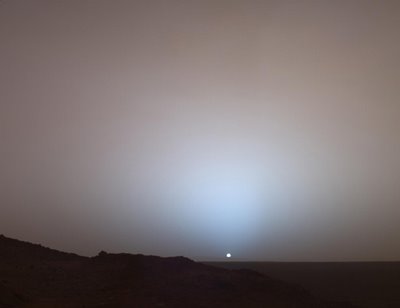
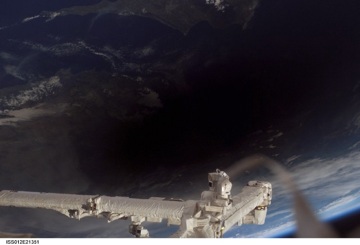 Most creatives look at stuff nobody else does. And ok, I admit it, I like funky phenomena in nature. No, not things like, how did Jessica Simpson even get a SAG card. I mean some things you see every day (or not) and may never have been aware of. The first image is taken from the International Space Station of the recent total eclipse - as it appeared from space. The dark spot is the shadow of the moon on the earth. Courtesy of boingboing.net. In effect, it’s what the earth looks like when not exposed to the sun, but here, the effect is eerie.
 And the second cool thing is the so-called “Belt of Venus” seen at sunset. It appears as a bluish-gray haze just below an area of bright pink right after the sun goes below the opposite horizon. That’s actually the earth’s shadow being reflected into the atmosphere.
Tags: astronomy, Belt of Venus, lunar eclipse, phenomena, Jessica Simpson
Subscribe to:
Posts (Atom)